Game of Thrones Isn’t Nihilism—It’s Hard-Won Humanism
Someone on X told me they didn’t like A Song of Ice and Fire because it feels “borderline nihilistic” with themes that are “the most pessimistic view possible”—stuff “you should’ve figured out well before adulthood.”
I get the complaint. Martin’s world is brutal. Good people die for stupid reasons. Honor gets you killed. Idealism curdles into tyranny. The guy who saves King’s Landing gets called Kingslayer for three decades. If you’re looking for fantasy that validates your moral certainties, Martin will disappoint you. Hard.
But that complaint reveals a need for comfort, not earned wisdom.
Martin’s “pessimism” isn’t nihilism. It’s realism without guardrails. The people who find it unrealistically dark? They’re often the ones who’ve never actually faced the trolley problem in real life—only in philosophy seminars where the stakes are hypothetical and you get to keep your hands clean.
When you play the game of thrones, you win or you die. There is no middle ground.
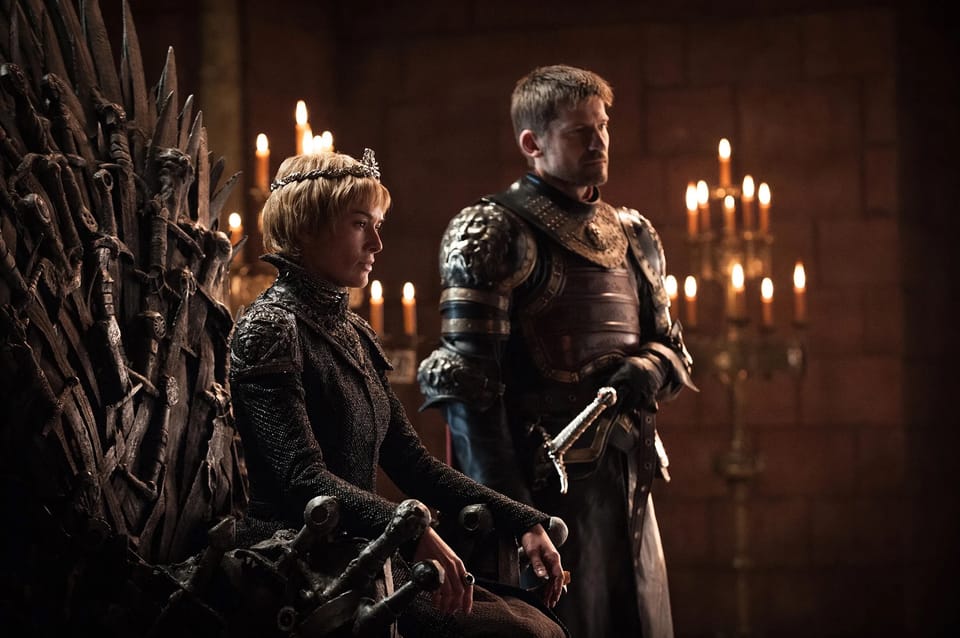
Cersei Lannister
Everyone “knows” honor matters.
Until honor costs you your head.
Everyone “knows” power corrupts. Until you’re the one holding it. Everyone “knows” vengeance is wrong. Until it’s your family butchered at a wedding.
Ned Stark knows truth and honor matter. That knowledge doesn’t help him when Cersei asks “What about my children?” He can tell the truth—rightful king, clear succession, proper order—and watch three kids die for the crime of existing. Or he can lie, compromise his principles, maybe spare them.
He chooses honor. It costs his daughters their father, his son a mentor, his wife her sanity, and the realm five years of war.
Was he right?
The books never answer.
That’s the point.
This is what separates theoretical knowledge from tested conviction. You can “figure out” that honor matters before adulthood. Write essays about integrity and moral clarity. Have perfectly defensible positions on duty and truth. Then you face the actual choice—where every option costs something irreplaceable—and all that certainty turns to ash.
So many vows… they make you swear and swear. Defend the king. Obey the king. Keep his secrets. Do his bidding. Your life for his. But obey your father. Love your sister. Protect the innocent. Defend the weak. Respect the gods. Obey the laws. It’s too much. No matter what you do, you’re forsaking one vow or the other.
Jaime Lannister
Jaime Lannister’s sworn to protect the king. Also sworn to protect the realm. Then his king—the one he’s supposed to guard with his life—orders him to bring his own father’s head. Plans to burn half a million people alive with wildfire.
Which oath wins?
Both positions are defensible. Neither’s acceptable.
Jaime kills Aerys. Saves the city. Gets called Kingslayer for the rest of his life by people who’d be dead ash if he’d kept his oath. Nobody asks which oath mattered more because everyone needs their moral certainties simple: oathbreakers are bad, regicides are bad, therefore Jaime’s bad. Done. Next question.
My friend on X said about characters like Jaime: “If I knew someone like those ones, I would never be near them again.”
Easy to say when you’ve never needed an alliance with a monster. When you’ve never served under someone whose orders made you complicit. When you’ve never had to choose which principle to sacrifice because keeping all of them meant everyone dies.
That’s not wisdom.
That’s the luxury of distance.
Kill the boy, Jon Snow. Winter is almost upon us. Kill the boy and let the man be born.
Maester Aemon
Daenerys Targaryen starts with the purest intentions I’ve seen in fantasy. She doesn’t want power for its own sake. She wants to break chains. Free the enslaved. Smash the wheel that crushes the poor. Every step seems justified in isolation.
Crucifying the masters? They crucified children.
Executing prisoners after they refused to bend the knee? They chose death over surrender.
Burning King’s Landing? They wouldn’t surrender, and she’d already lost everything.
At what point did “break the wheel” become “I am the wheel”?
Here’s what makes this vicious: Martin never gives you the clear moment of corruption. There’s no single choice where Daenerys goes from liberator to tyrant. Each decision makes sense given what came before. Each choice is defensible if you’re inside her head, watching her lose advisors and dragons and friends, watching her ideals crash against the reality that people don’t want liberation—they want stability, even if that means chains.
In my novel Godsbane, an agent of the god-king known as The Name—a true believer named Oqal—shows someone visions of what revolution will cost. Entire settlements wiped out by kinetic strikes. Children burning alive. Starvation and plague decimating entire worlds as warlords carve out fiefdoms. The galaxy spiraling into eternal misery.
Then comes the alternative: peaceful reform. Convince the revolutionary leader to join The Name as his consort, speak mercy into his ear, give her people a voice in the government. Prevent the galactic civil war that’ll kill trillions.
Oqal makes his case: “Think of the wretched misery and countless deaths we would avoid… If she continues down the path of violent revolution, she’ll be forced to make decisions that will strip away her humanity—strip away the purity of the woman you’ve devoted yourself to. She will change. War will turn her into something… monstrous.”
The character receiving this pitch—Avigayela, the protagonist’s most devoted friend—knows it’s manipulation. She’s vulnerable, recently broken, still piecing herself back together, and she knows Oqal’s targeting that vulnerability. But his words hold a certain logic, even morality, that she can’t deny. If there’s another path that could spare her people unimaginable suffering, maybe it’s worth considering.
When Avigayela brings these doubts to Sarai, the revolutionary leader can read the conflict in her friend’s mind. But later, when Sarai herself faces the choice directly, she feels the same pull: “If she stood at The Name’s side, she could intercede for her people… There were other ways to emancipate her people than declaring war.”
Whichever path Sarai chooses, the doubt won’t vanish with the decision, the moral scars will remain, and she’ll have to live with the consequences.
Readers who think “obviously collaborate to save trillions” have just revealed they’ll rationalize working with tyranny if you show them the body count. Readers who think “obviously refuse” might have the right instinct, but they haven’t sat with the weight of choosing revolution that burns worlds versus compromise that might—might—prevent it.
Lloyd Alexander wrote in his Westmark trilogy about revolution and political violence. The famous exchange: revolutionary leader Florian says you can’t make an omelet without breaking eggs. Protagonist Theo responds: “Yes. But men aren’t eggs.”
Alexander never resolves that debate. He wrote the books from his WWII combat experience and said explicitly: “I did not find answers to questions raised and I expect I never will.”
That’s not failure. That’s honesty.
Martin does the same thing. He doesn’t write nihilism—he writes the questions that haunt you for decades. The ones you test against every new experience. The ones that don’t have answers you can “figure out before adulthood” because they only reveal their full complexity when you’ve actually been tested.
“Can a man still be brave if he’s afraid?” “That is the only time a man can be brave.”
Bran and Ned Stark
In Born in Battle, my protagonist faces what looks like an impossible choice during a climactic ritual. Sacrifice his friend’s literal soul to prevent a dark god from escaping and consuming their world, or refuse and doom everyone. That’s agonizing. But it follows military logic people can grasp: one life versus millions, a soldier who’s already given his life once, enemy action forcing your hand under duress.
The real test comes earlier. The time loop paradox.
Bennett and his squad are abducted to a parallel world by an Aztec deity called Smoking Mirror. But they’re not the first. Smoking Mirror’s been doing this for centuries—maybe longer—pulling people from other worlds and trapping them in his domain. The timeline’s broken, looped back on itself. History keeps repeating with variations, and every iteration creates new people who wouldn’t exist in a “normal” timeline.
First-to-Dance is one of them. Born from this fractured history. She thinks, feels, loves. Cogito, ergo sum. She’s as real as anyone. But according to Sanchez, she’s also “not really real.” An anomaly. Never meant to exist.
Breaking the loop would restore the “proper” timeline. Send everyone home. Undo Smoking Mirror’s crimes. Rescue everyone who was abducted, including soldiers who died. It’s mathematically the right answer: restore the natural order, save the dead, bring everyone back to their proper worlds.
Except it’d be genocide.
Not just Dance. Potentially an entire world. Smoking Mirror’s been abducting people for an unknown length of time. They’ve had children. Their children have had children. For all Bennett knows, every human in this world’s descended from Outworlders. A whole civilization that happens to exist because of a paradox—but that does exist—would simply cease. Not die. Worse. Un-made. Erased from ever having been.
And Dance stands right there during the debate. Looking at them. Fully aware of what’s at stake. She asks: “Who has the right to decree my existence isn’t worth saving? Perhaps I’m an anomaly in history, Sergeant Sanchez, perhaps I wasn’t meant to be, but I still exist. Cogito, ergo sum. I live. I love. I feel pain and joy. I’m as real as you, no? What has happened has happened and the dead are dead. Would you trade my life for theirs?”
Bennett has to choose. Create the temporal anchor during the ritual and fix the timeline—making everything that happened in the loop part of the “true” timeline, preserving Dance’s world but condemning the abducted to remain displaced forever, including dead soldiers who’ll stay dead. Or don’t. Break the loop. Restore the “proper” timeline. Bring everyone home, resurrect the dead, undo all of Smoking Mirror’s crimes—and erase an entire world that “shouldn’t” exist.
There’s no certainty about which timeline’s actually “right.” Sanchez argues the loop’s an aberration that needs correcting. Brown counters with physics: maybe the loop itself’s a consistent part of history and this world isn’t an anomaly at all. They’re debating metaphysics without any way to know which choice leads to the “better” timeline. Just different versions of mass death.
The readers who think “obviously break the loop, restore the proper timeline” have revealed they’ll commit genocide if the math favors it and they can rationalize that the victims “weren’t supposed to exist anyway.” The readers who think “never, Dance’s right to exist is absolute” have revealed they’d condemn everyone Smoking Mirror abducted to remain trapped forever, including dead soldiers who could’ve lived, rather than unmake a world that shouldn’t exist.
The readers lying awake at 3am? They understand you’re not choosing between right and wrong. You’re choosing which version of mass casualty event you can live with—and there’s no moral high ground anywhere in sight.
Martin does this constantly. Not the big dramatic sacrifices—those are almost easy because they follow rules we understand. He stages the ones where the rules themselves contradict. Where doing the “right” thing requires accepting consequences that should be unacceptable. Where every choice available to you’s a form of monstrosity. Tyrion at the Blackwater ordering wildfire that’ll immolate thousands—soldiers and civilians both burning alive so the city doesn’t fall and everyone dies anyway, probably worse. Jon Snow executing a child for disobeying orders because command requires examples and mercy would destroy discipline. Arya becoming a killer to survive because the alternative’s dying nobly and uselessly.
Characters making genuinely wrong choices for defensible reasons and living with what that makes them.
I am not a hero, Sam. I’ve killed brothers of the Night’s Watch. I’ve killed wildlings. I’ve killed men that I admired.
Jon Snow
My friend claimed ASOIAF’s “even more unrealistic, not more realistic” because most people’s lives contain genuine friendship, honor, and kindness alongside darkness.
True. And Martin’s world contains those things too.
Sam and Gilly. Brienne and her oaths. Davos and his loyalty. Grenn and his brothers at the Wall dying to hold a gate. Small kindnesses between broken people who choose decency when it’d be easier not to. What makes them precious is they’re costly. Not inevitable.
Sam’s loyalty to Jon gets him mocked and nearly killed. Brienne’s honor costs her everything—her beauty, her innocence, her chance at the life she wanted. Davos’s integrity gets his sons killed and earns him nothing but grief. They persist anyway.
That’s not nihilism. That’s hard-won humanism.
The difference between Martin and Tolkien isn’t that one has goodness and the other doesn’t. It’s that Tolkien gives you eucatastrophe—good triumphs because narratively it must. The world bends toward justice because that’s how the story works. Martin gives you good that persists despite. Characters who choose decency knowing it’ll cost them. Virtue that matters precisely because the world punishes it instead of rewarding it.
Which is more realistic?
Look at history. The French Revolution started with “liberty, equality, fraternity” and ran straight into the Terror and Napoleon. The American Revolution declared “all men created equal” and maintained slavery for another 89 years. The people leading those movements weren’t evil. They “knew” the right principles. They’d figured out the themes well before adulthood. Knowledge wasn’t enough when power, fear, and necessity entered the equation.
Martin shows you that process. Not because he’s pessimistic, but because pretending it doesn’t happen would be a lie.
Most men would rather deny a hard truth than face it.
Tyrion Lannister
When my friend said the themes are “stuff you should’ve figured out well before adulthood,” they revealed something. Not sophistication. Not wisdom. Comfort.
They’ve had the luxury of never having their principles truly tested. Never facing a situation where duty to family conflicts with duty to realm and you can’t preserve both. Never watching good intentions curdle into tyranny from the inside. Never needing an alliance with someone whose past makes them monstrous but whose present makes them necessary.
Until they’re actually at the lever.
Martin’s genius is removing that distance. He strips away the fantasy convention that good people win and asks: what would power actually do to these people? What does honor cost when the world punishes it? What happens to your idealism when it crashes against reality’s indifference? The darkness isn’t there for shock value. It’s there because pretending it doesn’t exist would be a lie—and that lie would make the genuine moments of decency meaningless.
Sam matters because he stays kind in a world that punishes kindness. Brienne matters because she keeps her oaths in a world that mocks them. The small acts of grace between broken people matter because they’re chosen, not inevitable. That’s not nihilism. That’s showing you what virtue actually costs when it’s real instead of performative.
Lloyd Alexander wrote about his Westmark trilogy: “This wasn’t an attempt to exorcise my demons. No, I keep and cherish those demons. I like to believe they’re my conscience.”
He didn’t resolve the questions about justified violence because the questions matter more than false certainty. He wrote from combat trauma and said he never found answers. Martin does the same. He raises questions that haunt you. Questions you test against every new experience. Questions that only grow more complex the longer you live with them.
Men aren’t eggs. Power corrupts even the well-intentioned. Good people make terrible choices. Sometimes there are no good options—only varying degrees of awful.
You don’t “figure out” these themes before adulthood. You carry them for decades. You test them. You revise them. You live with the discomfort of not having clean answers. The person who thinks they’ve solved them? Who finds Martin’s darkness unrealistic? Who wishes the themes were simpler?
That’s not wisdom. That’s the luxury of never having genuinely faced the trolley problem in real life—only in philosophy seminars where the stakes are hypothetical and you get to keep your hands clean.
Martin denies you that luxury. He puts you at the lever and forces you to choose. Then he makes you live with the consequences. That discomfort? That’s what hard-won humanism feels like when you’re honest about what it costs.
The readers who can’t sit with it need their fiction to protect them from reality’s edges. The readers who lean into it—who recognize they’re being tested and engage honestly—those are the ones capable of wrestling with humanity’s hardest questions instead of pretending they have easy answers.
Some questions don’t resolve. Some moral weight you carry forever. Some choices haunt you decades later. That’s not pessimism. That’s being human. Because in real life there are no guardrails.
And Martin trusts you enough to face it.



Member discussion