The Morning After

Most space opera ends when the tyrant falls. The rebels breach the palace, the emperor is defeated, the oppressed masses cheer, and the credits roll—maybe there’s a coronation, definitely a kiss. The story’s over because the story was always about getting there: the scrappy underdogs, the impossible odds, the climactic battle that settles everything. What happens to seventy trillion people on the morning after the collapse of three thousand years of theocratic tyranny is dismissed with a hand-wave.
I refuse to hand-wave.
Dark Dominion is a planned five-book sequence, but the first two novels—Immortal and Godsbane—form a complete duology with a satisfying arc: Sarai izt Kviokhi wakes on a desert moon with no memory, discovers she’s pregnant with a child that shouldn’t exist, and over the course of two books fights her way to deposing the immortal god-emperor who has ruled the galaxy for three millennia. The tyrant falls. It’s enormously satisfying. It’s also, by design, the midpoint of the larger story—because I believe the most interesting question in revolutionary fiction isn’t can you overthrow the monster? It’s what do you become in the process, and what do you build from the wreckage?
But that question doesn’t even wait for the sequel trilogy. It’s alive in every chapter of the duology, and it’s what makes the revolution feel different from the comfortable rebel fantasies most space opera trades in.
Sarai doesn’t lead a unified resistance. She leads a coalition that can barely stand to be in the same room.
The people who want to overthrow the Dominion can’t agree on whether violent revolution is justified, can’t agree on what acceptable casualties look like, can’t agree on what comes after, can’t even agree on the foundational prophecy underpinning everything, and carry the oppressor’s prejudices embedded so deeply in their own moral frameworks that they don’t even recognize them as inherited. The revolution’s fractures aren’t political subplots running alongside the real story of space battles and psionic combat. They are the story. The space battles exist because the arguments failed.
Early in Immortal, Sarai—still operating under an amnesiac identity—sits on a sandcrawler crossing the desert with Lenaja, a young Mešvi nomad who has taken her in. Lenaja describes her people’s vision of the future: a world where the divisions between peoples dissolve, where everyone is united and free. It’s beautiful and sincere. Then Sarai asks about the ruling caste, the Scions, and the warmth vanishes. Lenaja uses the same biological essentialism the Dominion uses to oppress her people—just inverted, just redirected at a different target. Within the same conversation, she reveals cultural practices among the Mešvi that mirror the Dominion’s own eugenics, just wearing different justifications. When Sarai is horrified, Lenaja fires back with evidence of the Dominion’s parallel practices. Neither woman examines the contradiction in her own position. The text doesn’t editorialize. It simply lets two oppressed people reveal how thoroughly the system has embedded itself in their moral intuitions—including the ones that oppress others.
This isn’t an isolated moment. The Mešvi have their own religion, their own matriarchal traditions, their own exclusionary practices they frame as cultural preservation. Other peoples carry their own prophecies about who the liberator will be and what she owes them. The Mešvi Consortium—the bankers and brokers who run the galaxy’s grey market—has ambitions extending well beyond liberation. The coalition that forms around Sarai is held together by a shared enemy, not shared values—and the text makes clear that shared enemies are a terrible foundation for governance.
Space opera almost always treats the oppressed as a unified bloc. Dark Dominion’s subjugated peoples are fully realized cultures—distinct languages, religions, social structures, and moral frameworks that predate the Dominion and will outlast it—and the friction between them is where the political realism lives.
And these arguments aren’t abstract philosophy conducted in war rooms either. They literally play out in Sarai’s own body.
Her nanoculture—the symbiotic technology implanted in her as a child, without consent, by the institution that took her from her family—is simultaneously the thing keeping her alive, the thing that made her impossible pregnancy possible, and paradoxically the thing that could kill her. When she manifests her exponentially growing psionic abilities far beyond her training to manage safely, she faces physical consequences. Cerebral aneurysms. Strokes. The nanoculture repairs the damage by eating her own body mass—stripping fat reserves first, then lean muscle, leaving her smelling of ammonia from protein breakdown. She fights the revolution while her own biology devours her.
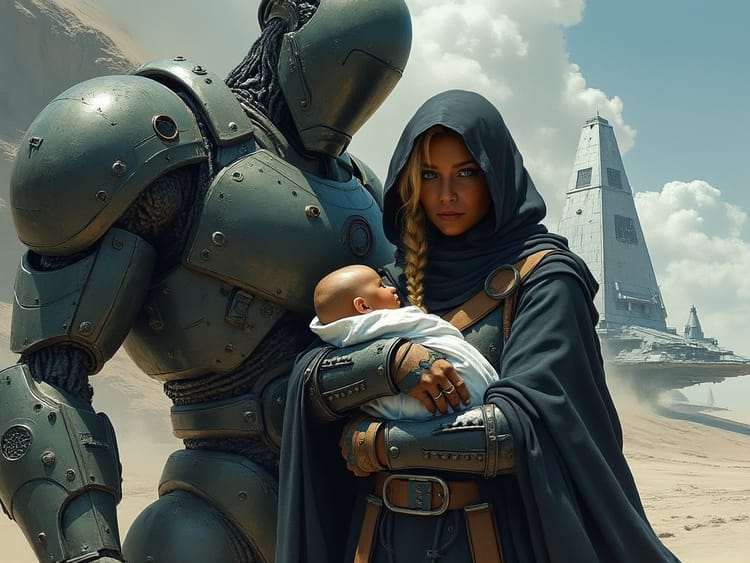
Sarai’s pregnancy was itself a biological impossibility—the nanoculture performing unauthorized gene editing in real time to harmonize chromosomes that shouldn’t be compatible, building a viable child from genetic material the empire’s entire caste system was designed to prove couldn’t combine. Her womb became political property before she even knew she was pregnant, because her daughter’s existence disproves the foundational lie that justified three thousand years of slavery. The child is biological proof that the empire is a con. Every faction in the galaxy wants to either claim that proof or destroy it, and Sarai’s maternal drive to protect her daughter is what drags her into the revolution in the first place—not ideology, not destiny, not righteous anger, but the brutal calculation that the only way to keep her child safe is to burn down the system that wants them both dead.
The revolution costs Sarai her bodily autonomy in ways the text refuses to look away from. It costs her allies in ways that are equally specific. And the debates about whether those costs are justified don’t have clean answers, because the text stages them as genuine arguments between people who are all partially right.
A well-meaning reformer within the Dominion imagines Sarai willingly taking her place beside the god-emperor, speaking mercy into his ear, gradually transforming the system from within. His vision is compassionate, sincere, and genuinely hopeful. The text takes it seriously enough to show what that vision actually produces when implemented by power with no intention of relinquishing itself: a cloned puppet of Sarai paraded as a symbol of reform while the system remains intact. The reformer’s dream made literal—and it’s horrifying.
Others argue from equally defensible positions—that damnation is already the price of revolution and one more sin doesn’t shift the calculus, that the Dominion won’t be debating morality when the fighting starts, that psychological manipulation doesn’t invalidate the logic it was used to plant. Every voice in the coalition gets its strongest possible argument, and none of them are simply wrong.
And Sarai—the woman who has to lead all of them—argues tirelessly that ends don’t justify means and evil begets evil, but when pressed puts her head in her hands and says she doesn’t know. She doesn’t know if she’s capable of what the revolution requires. She doesn’t know if she can lead without becoming what she’s fighting. The text doesn’t rescue her from the uncertainty. It doesn’t offer a philosophical framework that resolves the tension. It lets every position have its best articulation and leaves the reader sitting in the same discomfort as the characters.
Herbert saw this problem. The Dune saga treats the jihad as tragic inevitability—the cost of charismatic leadership, a catastrophe Paul can foresee but not prevent. The moral horror is real, but it’s also fatalistic: the current was always too strong, and Paul was never going to swim against it. Dickinson’s Baru Cormorant resolves it differently—you become the empire to destroy it, and the series traces what that corruption costs with merciless precision. Both are valid narrative choices, and both locate the tragedy in a single protagonist’s relationship to power. Dark Dominion makes a different one: it stages the debate across an entire coalition and refuses to adjudicate it.
And then the fighting starts anyway, because the Dominion’s atrocities don’t wait for the revolutionaries to achieve moral consensus.
The duology ends with the tyrant defeated and imprisoned—and with Sarai sitting in his rose garden, still in her armor, trailing her hand in a fountain while sirens wail and gunfire crackles outside the palace walls. She’s been Princess Mother Regent for minutes. She’s already making promises to the god-emperor’s pregnant teenage wives about their children’s safety. She’s already navigating succession politics. The city is burning and the loyalists are still fighting and the looting has started, and Sarai—the woman who just ended three thousand years of theocratic tyranny—tells her partner: “It hasn’t even started.”
She’s right.
The duology is a complete arc. Sarai goes from amnesiac fugitive to the woman who brings down an empire, and the story earns its climax through everything it costs her and the people she loves to get there. The romance at the center—a survivor of sexual violence learning to trust again, and the engineered killer learning patience and gentleness—is load-bearing in a way that space opera romance rarely is, because the intimate damage is the mechanism through which the reader understands what the empire actually does to people. The psionic combat is visceral and physically costly. The political maneuvering is sharp and morally complicated. The world-building runs deep enough to include constructed languages that encode cultural identity and power relationships. As a two-book story, it works. It’s satisfying. The tyrant falls and the people you’ve come to care about survive.
But the reason I planned five books is that I believe the hardest part of revolution is what comes after. History suggests—with a consistency that approaches iron law—that post-revolutionary systems frequently become as oppressive as what they replaced. The French Revolution produced the Terror and then Napoleon. Russia produced Stalin. Iran replaced a monarchy with a theocracy. The Dominion is a galaxy of seventy trillion people who have never known anything but theocratic feudalism, and the complications of building something new from that wreckage are staggering: Scion noble houses vying for sovereignty with hundreds of the god-emperor’s literal sons as rival claimants, a grey-market economy that wants to go legitimate, an entire caste of people emancipated from serfdom with no infrastructure for economic participation or self-governance, allied factions whose unity depended on a shared enemy that no longer exists, and at the center of it all, a child—Sarai’s daughter Mikhalah—who was born as a political symbol before she was born as a person, and who will eventually develop her own agency, her own agenda, and her own relationship to the prophecies that claimed her before she could speak.
The sequel trilogy follows that story: the transition from revolution to governance, the question of whether Sarai can build something just from the ruins of something monstrous, and the growing tension between a mother’s fierce protectiveness and a daughter’s right to choose her own path—prophecies be damned.
But you don’t need those books to feel the weight of what’s coming. It’s already there in the duology’s final scene, in Sarai’s voice when she says it hasn’t even started, in the sirens and the gunfire and the weeping wives and the burning city. The revolution succeeded. Now comes the hard part.
Space opera loves the rebellion. I’m much more interested in the morning after.



Member discussion